









Contact me!
Check this article out in Kerrville's Hill Country Community Journal!
Recent posts

What I’m Reading – August 21, 2026

Mark Helprin has written yet another captivating, gut-wrenching novel called The Oceans and the Stars. He is one of my favorite authors, probably because his prose is poetic, lyrical, yet powerful. His descriptive powers engender remarkable images of people and places in the imagination and provokes a visceral reaction to every scene whether tender or violent.

The Oceans and the Stars is about a naval captain who gets sideways with the President and is punished by being denied promotion and placed in command of a vessel below his rank and experience. The ship he’s assigned to, the Athena is a littoral cruiser that is one of a kind because the administration and the navy decided that close to shore combat was inferior to long distance warfare.

Dispatched to the Indian Ocean on essentially a suicide mission, Captain Rensselaer and his crew have to fight external and internal enemies. It is a story of honor, loyalty, and love. It explores the concept of just cause, ‘casus belli’ and the willingness to sacrifice one’s future and one’s life in that cause. And it is a hell of a good war story and love story to boot.

I am also reading, slowly, an Italian mystery, which Italians call ‘gialli’ or yellows, entitled L’uomo del Porto. It is one book in the series about an Italian police investigator named Vanina Guarrasi. It is also a television series. Like the Makari series, I have two purposes for reading them; okay, maybe three. First, to improve my Italian language skills; second, to see how close the tv series comes to the novels; and third, for pleasure. I have not seen an episode based on this book, so I can’t really comment on how true to the story the series is, but most of the characters seem aligned.

Finally, and maybe I should mean that in the sense of ‘at last’ I’m reading Life and Fate, by Vasily Grossman. I’m only 286 pages in, but already it looks to be an indispensable addition to my library that I will read more than once (it’s only 871 pages after all). Structured somewhat like War and Peace, the novel is broken into parts that tell the stories of different characters during World War II (or World War Eleven to some) and more specifically the siege of Stalingrad. Born in 1905, the son of Ukrainian Jews, Grossman was an award-winning combat journalist during that time. But he had also lived through the Stalinist purges and the deliberate starvation of Ukrainian ‘kulaks’ of the 1930s and became disillusioned with communism. Somewhat slowly at first he builds ultimately on the analogous natures of Communism and Nazism, which is certainly not a stretch since NAZI is the acronym for National Socialist Workers Party. As Orwell did in 1984 he describes the tools of tyranny inherent in the two systems, one of which is the rewriting of history. “No one talked like this before the war. The might of the State had constructed a new past. It had made the Red Cavalry charge a second time. It had dismissed the genuine heroes of long-past events and appointed new ones. The state had the power to replay events, to transform figures of granite and bronze, to alter speeches long since delivered, to change the faces in a news photograph. A new history had been written. Even people who had lived through those years had now to relive them, transformed from men to cowards, from revolutionaries to foreign agents.” The other tool of tyranny he shines light on is the precedence of the State over the individual. “ ‘No,’ said Madyarov, ‘there are two distinct principles. Stalin does not build what the people need—he builds what the State needs…The needs of the State are one pole; the people’s needs are the other pole. These two poles are irreconcilable.’” These two examples are eerie warnings of what many seeking and holding power today will do if given enough of it.

That, however, is not the main theme of the novel so far. It is more the exploration of human nature in crisis. The sacrifices and privation his real mother endured—she was murdered along with thousands of other Jews by the Nazis—are reflected in the letter from a mother to her son on the eve of her death at German hands, as are those of citizens in the U.S.S.R’s murderous system of gulags, show trials, mass starvation, forced collectivization and a host of other horrors perpetrated upon them. During the reign of Nikita Kruschev, Grossman’s book was ‘arrested’ though he himself was not. Seen as dangerous to the Soviet Union they confiscated and destroyed the known copies of the novel, the carbon copies, and even the typewriter ribbons on which it was written. Fortunately, he had the sense to give two copies to close friends and never told anyone about them, and Life and Fate finally got published in 1980.

I have always admired Russian writers tremendously. Dostoyevsky might just be my favorite writer of all time. Whether it is him, Tolstoy, Bulgakov, Nabokov, Gogol, Chekhov, or Solzhenitsyn their ability to tap into the human soul, the psychology of man is other-worldly to me. Yet, I despise Russia’s entire bleak history. And I think Grossman sums up my feeling in this passage: “Shargorodsky was a very gentle man and quite helpless in any practical matter. He was the sort of man about whom people say, ‘He’s got the soul of a child,’ or ‘He’s as kind as an angel.’ And yet he could walk straight past a hungry child or a ragged old woman begging for crusts, feeling quite indifferent, still muttering his favourite lines of poetry.” The nation never lives up to their poets’ sense of value or compassion for the individual. Later in the novel Grossman elucidates this idea himself when one of his characters says, “Chekhov is the bearer of the greatest banner that has been raised in the thousand years of Russian history—the banner of a true, humane, Russian democracy, of Russian freedom. Of the dignity of the Russian man. Our Russian humanism has always been cruel, intolerant, sectarian. From Avvakum to Lenin our conception of humanity and freedom has always been partisan and fanatical.”

Quite a statement. Well, I’ll write more, perhaps, when I’ve finished, but that’s it for now.

March Reads

Lately, I’ve just finished reading The Pathfinder by James Fenimore Cooper. An eon or so ago, or when I was in junior high, I read The Deerslayer and The Last of the Mohicans. Cooper wrote five books chronicling the life of Natty Bumppo, (the three mentioned plus The Pioneers, and The Prairie) who is almost never called that in the books but always bears an appellation that describes an aspect of his character. He is variously called Natty, Deerslayer, Hawkeye (yes, that’s where Mash got the name), and Pathfinder. Interestingly, Cooper did not write these books, called The Leatherstocking Tales, in chronological order. He began with the last book, and as time went on decided to fill in the blanks.

So, why did I decide to read Cooper again? Well, first and foremost, I liked the books very much when I read them those many years ago, and I wondered if I would still like them or if I’d ‘outgrown’ them. Somewhat to my surprise I enjoyed the book; however, my enthusiasm was tempered by Cooper’s wordiness. I admire descriptive writing, but Cooper goes overboard. Even Mark Twain, a near contemporary, thought his writing was overwrought.

That said, I can see the influence Cooper, Dickens, Austin, Eliot, Dumas, and other 19th century writers have had on my penchant for description. Because description of people and places can be symbolic and create mood, it is a valuable tool in the writer’s toolbox. While the minimalist style of a Hemingway is effective and has its charm, I find myself drawn more towards the rich, poetic style of a Mark Helprin. If you’ve read A Soldier of the Great War by Helprin you know what I mean. His lyrical style transports the reader into the world and the time as if one is a witness to the events he narrates. Thomas Wolfe called writers poets, and I believe in and aspire to that highest form of the literary art in my writing.

February Valentine Events

The Saturday before Valentines Day — the 7th of February — I will be at the Castroville Library for a meet and greet and perhaps a short reading from 10:00 till Noon.

Hope to see you there.

Then, my wife and I are having another event at the Do-Re-Me Lavender Farm in Moore, Texas on Valentines Day (Feb 14).

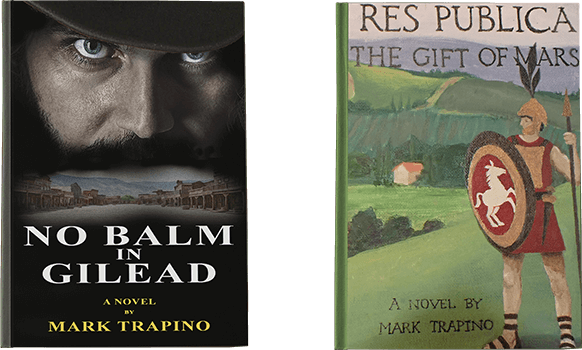
It’s an opportunity to meet the author and get a signed book (either or both of The Gift of Mars or No Balm in Gilead), and take an art class on making jewelry. Not to mention see and experience the Lavender Farm which also has a gift shop, a coffee and wine bar, and some live music by the proprietors as a rule.

Download this flyer here.

Download this flyer (Italian) here.

Fall Family Art and Author Event

Nov. 22, 2025: The Twig Bookstore, in the Pearl District, San Antonio, TX

Sit and Sign event. Come and meet me, talk about books, and buy a signed copy.

*Update* Here is a link to our event! Come see us! Mark Trapino @ the Twig !

Nov. 8, 2025: Fall Family Art and Author Event @ Doe-Re-Mi Lavender Farm, 1381 County Rd. Moore, TX.

I will be reading excerpts, talking about my books, and signing copies.

And supposedly playing guitar and singing, but we shall see.

There will be music, beer and wine, and food in the Lavender Farm gift shop and café. The owners are fabulous musicians and they will play real music for your enjoyment.

Their lavender farm is amazing. They will have all kinds of plants for sale, including the lavender. And the Hobbit house chicken coop is a work of art you can’t miss!

Come join us!

What I’m Reading

Sometimes I think it would be easier to list what I’m not reading. As usual, I have way too many books going at the same time. Practically one for every room and occasion in the house. Here’s the short list of five I currently have going. Two are novels and three are nonfiction.

Il Fatto Viene Dopo is an Italian who-done-it by Gaetano Savatteri, part of his Makkari series. It is quite different, I would say, from the television series on the Italian Rai 1 station. It is also available with subtitles on Amazon Prime video if you subscribe to the Mhz Channel. It is of especial interest to me because it is set in the Province of Trapani where my family came from. Aside from that, he develops an interesting cast of characters and does a good job of keeping you guessing about who the guilty party is.

Another Italian novel I’m reading is La Ciociara, by Alberto Moravia. It is set primarily in the Province of Abruzzo, which lies due east of Rome, during World War II, and it tells the heartrending story of a mother and daughter caught up in the horrific violence that took place in that part of Italy during the war. Thousands of Italian women were raped and their men murdered by Free French forces from their colonies in North Africa as they fought the Nazis. It’s a tough read. It also was made into a movie starring Sophia Loren in the 1960s.

Because I am working on what you might call a sequel to my historical novel, Res Publica: The Gift of Mars I’ve been reading Comedy and the Rise of Rome by Matthew Leigh. It is an interesting treatise on how the comedy of Plautus, Terence and others was used to comment on Roman ideals and attitudes of the times. I expect it will be very useful in the plot and character development in my latest endeavor to recreate Republican Rome.

Also, peripherally related to my second Roman historical novel, part of which takes place in Greece, I’m reading Thucydides’ The Peloponnesian War. While this war took place hundreds of years before the events and timeframe of my novel, Thucydides gives some great insight into how the Greeks waged war, and the power politics that roiled and embroiled Greece in a constant state of war for over twenty years. The battles on land and sea, the utter barbarity with which they treated prisoners, and the perfidious nature with which they broke truces, treaties, and alliances, all sworn with holy oaths before the gods and justified with brilliant oratory and demagoguery, make one despair that people and nations will ever remain true to their word. Which is one of the reasons Rome got dragged into wars there repeatedly after punishing Phillip of Macedon for siding with Hannibal against them.

The War of the Roses by Dan Jones, though not specifically tied to my medieval endeavor, is very instructive of that time period. The majority of it takes place, really, in the early years of the Renaissance, but the knightly ideals and the feudal economics still pertain. It is a fascinating history, and if I’ve derived one thing from it, it is gratefulness that we live in a Republic that has had a peaceful transference of power for 250 years. For 150 years the English fought over which family owned the rights to the throne of England, the Yorkist or Lancastrian Plantagenets, and they ended up with the Tudors. Reading The Peloponnesian War and The War of the Roses, solidify the concept that tyranny and the lust for power, whether it be monarchical, dictatorial, or oligarchical always results in the destruction of lives, livelihoods, property, and liberty. But it certainly makes for enthralling reading.

New Voices

There are some wonderful writers out there who deserve to be read but aren’t published by the publishing houses. While I hope to add to the list, these four that I start with are all friends of mine who I found out after we became friends were also writers. I have read some of their books and found them to be as good or better than many you find on bookstore shelves. So take a look at them.

Dan Ginsberg is a Denver writer. We became friends when we were both teachers at a Denver high school and spent many mornings before classes started discussing our creative projects. Time I ostensibly used to prepare for my classes. Anyway, Dan’s muse for most of his writing, was his admiration for Arthur Conan Doyle’s Sherlock Holmes novels. Back then he worked mostly on screenplays but later turned to writing novels. His latest is a police series called The Banty Conners Trilogy. His protagonist is a delightfully quirky and unique female police detective, and the books are flat out hard to put down.

Norbert Jacobs is a retired police officer and has myriad stories of his time on the force. Some are hilarious, and some are harrowing. His life in general is quite interesting as his family immigrated to the United States from Belgium in the 1950s. As a nine-year old who spoke no English he had to adjust, adapt, and assimilate into the strange new world of Texas that was like another planet. He is a great story teller and finally put some of them on paper in his first book, an autobiography titled Sojourner. His second book is a compilation of stories depicting police on the job. Some are his experiences, and some are the experiences of various friends and colleagues that served with him on the force. The book is titled What Do You Say to a Naked Lady? Both are great reading mixing the laughter and serious business of life.

Another favorite is Clabe Taylor, a nom de plume, who writes fantastically funny, satirical, ironic spy thrillers with an underlying seriousness to them. His spy books are very loosely based on his experience in the “business.” He is no one-trick pony, however, and because of his fluency in other languages his interests and subjects range far and wide. That said, the two books I have read thus far are in the spy thriller genre. On the Lam and Mako are two rollicking good reads that will keep you laughing and at the same time wondering about how the U.S. intelligence services really operate. Read his books!

D. Kenton Mellott writes some humorous and thought-provoking Sci-Fi novels combining the temporal and the metaphysical worlds. He blends raging hormones with electromagnetic powers to take you on a whirlwind adventure that just might leave you questioning reality. It’s Carlos Castaneda on steroids…or electromagnetic impulses; I’m not sure which. Don’t be fooled, there’s some real thought and philosophy behind Mellott’s writing which adds depth and dimension to the story telling. So sit back and enjoy Exophobe and its sequel, Exophobic.

In the Works

As usual, my imagination wants to take me in various directions. Story ideas boil up in my head at the least provocation, it seems. I have to rein them in to keep from going down rabbit holes and losing focus on “the main idea.” Still, like my reading habits, I tend to have multiple irons in the fire. I jot down notes on story ideas in hopes that I will someday get to them. If I live long enough. Talking with my friend, Dan about this subject the other day he laughed and asked, “How long do you plan on living?” I just can’t help myself, I guess. At any rate, here’s what I have in the works at the moment.

Though not truly a sequel to The Gift of Mars, I am working on another historical novel on the Roman Republic. My original plan was to write 4-5 books chronicling the rise and fall of the Republic that lasted nearly 500 years. I have decided, however, not to worry about writing them in chronological order. Maybe Dan’s joke touched on a truth that’s been rolling around in my brain for a while, and so I have gone straight to what I planned as the final book. The working title is A Requiem to Concordia, and it involves the same Tempanius family 350 years later. Whereas The Gift of Mars begins in 495 BC, this one takes place from 146 to 133 BC. Technically, the Republic carried on for seventy years or so after this date until the arrival of Julius Caesar, but it was a Republic in name only by then.

I hope to fill in the middle 350 years in the future. We may have to move to Italy again to do it. “Please bre’r bear and bre’r fox, don’t throw me in that briar patch.”

The second book I’m working on, though less often, is also set in Italy. This one, however, is much more modern. It takes place in the 1350s. Ha, ha, gotcha! For obvious reasons I don’t want to go into too much depth or detail, but suffice to say it’s about a medieval bounty hunter up north around Milan (another reason we may have to live in Italy for a while). His name is Aldo, and in the first episode he is hired to track down a thief who has stolen poems from Petrarch. The working title for it is The Sonnet Thief. This would also be a series, and I have three or four plots for future Aldo books already in mind.

So, if you like my books so far, pray I live long enough to write the others. Quite a few people who have read No Balm in Gilead have asked me if I plan a sequel to it, but at this juncture I have not. I always wanted to write a Western, and at present that’s it.

Check back and see if I’ve made any progress!

Biography

If you looked up the expression “jack of all trades and master of none” in your book of idioms (everyone has one, right?) you would find my picture there. I have tried my hand at so many jobs I suppose I have forgotten half of them. Rest assured it wasn’t all inability to focus or stick with something. The way I saw it, a writer needs experience if he expects to be able to create realistic fiction. Even if he is writing fantasy. The heart of story-telling is character development; if characters don’t reflect the best and the worst and everything in between of the human condition then readers cannot suspend disbelief and engage with the tale.

No offense to fans of John Grisham or Tom Clancy, but their formulaic, cardboard cutout characters don’t hold a candle to the personalities developed by Saul Bellow, Dostoyevsky, George Eliot (Mary Ann Evans Cross), Henry James, Dickens, Jane Austen, Willa Cather, Flaubert, Proust, Faulkner, Flannery O’Connor, Garcia Marquez, DeBernieres, or Pirandello to name just a few of the literary luminaries who have exposed the good, the bad, the beautiful, and the grotesque of the human condition. These and their ilk are the writers I aspired to emulate.

But I digress. I believed the best way to get to know what makes people tick is to associate with as many types as possible. Until later in life I trended toward the blue-collar professions. As a kid I loved to read, but I hated school. College was not a priority, so I worked in restaurants, car washes, landscaping, warehouses, factories, lumber yards, construction projects, tour guide companies. I worked as a lumberjack, fisherman, heavy equipment mechanic, and even as a camp cook on a remote construction project at the most northern point of Alaska. Hey, anybody can stay at a job forever, it takes an expert to continually find another! The point is, all these jobs and the people I met in the course of working them introduced me to myriad types, archetypes if you will, to help me put flesh and bone to my characters.

It was an unfettered life. I owed nothing and owned little for a long time. I have never feared change (although I do fear heights), and while that has not benefitted me much financially, it has made my life interesting. I came and went as I pleased but held onto friendships that have lasted a lifetime. But, as is often our greatest blessing and our downfall as men, I met a woman—I mean, what’s a novel without romance—got married and settled down. Kind of. I got out of my comfort zone and worked various sales jobs from selling Kirby vacuum cleaners door-to-door, to high tech equipment. Then my wife and I both got an itch.

We sold everything, house, cars, furniture, and relocated to Italy for a year. There, culminating ten years of research, I wrote my first novel, Res Publica: The Gift of Mars living in the area near Rome where it all takes place. I learned to speak Italian, met distant cousins with whom we remain close, made lifelong friends, and became a certified Italophile. Upon our return we took up our old lives again, me selling high tech gear and Ren teaching art. We bought another house and cars and furniture. But soon change was again in the wind, and I decided I wanted to do something different.

Another drastic change came to mind, and I enrolled at a local college, got a degree in English and, ironically, became a teacher. A drastic change indeed for someone who hated school. During my first two years of teaching, I earned an MA in Liberal Studies with a concentration in creative writing from Denver University. I taught high school English for twelve years and loved it. As fate would have it, however, I had another novel building in me, so I decided to retire. We moved to Texas and I wrote my second novel a western called No Balm in Gilead.

Have I come to rest? Not sure. I may still have another change or two in me. Whatever the case, I certainly have plenty of stories to dredge up and put on paper.

Contact us!